We independently select all products and services. While we earn a commission from partner links, commissions do not affect our opinions or evaluations.
If you’re looking for a power wheelchair for a parent, a spouse or yourself, and most of the driving will happen at home, the questions are different from the ones in a typical “best of” list. Will it fit through the bathroom door? Can it turn around in the kitchen? Will it get stuck on the bedroom rug? Will it fit in the condo elevator?
This guide is a detail-by-detail comparison built to help you narrow the list down. It focuses on the numbers that decide whether a chair works inside a real home: width, length, turning radius, drive type and seat height. We also explain, in plain English, how Medicare’s in-home rule works, because for an indoor chair it often matters most of all.
Looking for a chair that folds for the car or for flights? See our best electric wheelchairs guide, which covers travel and folding models.
The short answer: If tight turns are the problem, the Quantum Q6 Edge HD has the tightest turning radius on our list (19.75 inches) and supports riders up to 450 lb, but it’s also the widest at 26.25 inches. For narrow doorways and small condo elevators, the Pride Jazzy Go Chair is 22.5 inches wide and 28.5 inches long without front rigging. If you’re going through Medicare and want a standard everyday chair, the Pride Jazzy Elite ES carries Group 2 standard codes (K0822/K0823). For complex seating needs, look at the Permobil F5 Corpus or the Merits Velocity. And if you plan to pay out of pocket, see our four self-pay picks.
In Miami-Dade or Broward? See if you qualify for a power wheelchair
Take our free 60-second assessment. If it looks like a fit, a local mobility specialist can explain Medicare or insurance coverage and next steps, at no cost and with no obligation.
Quick picks
| Pick | Best for | What stands out |
|---|---|---|
| Quantum Q6 Edge HD | Heavy-duty riders who need a tight turn | 19.75″ turning radius; 450 lb capacity |
| Merits Velocity | Power tilt and recline in a compact base | 24″ wide; power tilt and recline; optional 12″ seat elevation |
| Permobil F5 Corpus | Complex rehab and power seating | Up to 14″ seat elevation; 45° forward tilt |
| Pride Jazzy Elite ES | A standard Medicare-coded everyday chair | 22.75″ wide; Group 2 codes (K0822/K0823) |
| Pride Jazzy Go Chair | Compact homes and short elevators | 22.5″ wide; 28.5″ long without front rigging |
| Pride Jazzy Air 2 | Seat elevate for the kitchen | 12″ power seat elevation; drives while raised |
| Golden Cricket | Lightweight carbon-fiber chair | 22.5″ wide; 22″ turning radius; frame as light as 33 lb |
| Pride Jazzy Passport | Lighter riders who want a folding chair | 23.5″ wide; folds |
| Merits EZ-GO | Short travel chair for small spaces | 31.5″ long; 22.25″ turning radius |
Measure your home first (it takes 10 minutes)
The best power wheelchair for home use is the one that fits your home. Before you look at any chair, grab a tape measure and note these spots:
- The narrowest doorway the chair must pass through. It’s usually the bathroom.
- Hallway corners, especially where a hallway meets a doorway at a right angle.
- The bathroom: the open floor space in front of the toilet and sink.
- The kitchen: the gap between counters, or between a counter and the table.
- The bedroom: the space beside the bed where the rider will transfer.
- The elevator (if you live in a condo or apartment): door width and the inside depth, from the door to the back wall.
The doorway rule: subtract 2 to 3 inches
Measure the clear width of the doorway: the open space with the door fully open, not the frame to frame. A door that opens into the room, plus its hinges, can eat an inch or more.
Then subtract 2 to 3 inches. That leftover number is the widest chair you should consider for that door. The extra room protects knuckles, door frames and the joystick, and it means the rider doesn’t have to line up perfectly every single time.
For example, if your bathroom door has 26 inches of clear width, aim for a chair around 23 to 24 inches wide or narrower. If a doorway is close, a carpenter can often gain an inch or two with swing-clear (offset) hinges or by removing the door stop.
Turning radius, explained
Turning radius is how much room the chair needs to turn. Manufacturers usually list it as a radius, measured from the center of the turn out to the chair’s farthest point.
A helpful rule of thumb: to turn all the way around (180°), plan on a clear circle about twice the turning radius. A chair with a 20-inch turning radius needs roughly a 40-inch circle of open floor to spin around. Footrests and feet often stick out past the chair, so check whether the manufacturer’s number includes them, and add a little room if it doesn’t.
Measure the open floor in your bathroom, kitchen and at the end of hallways. If a room can’t fit that circle, the rider will need to do a three-point turn there or back out, which is fine now and then but tiring several times a day.
Length matters too (especially in elevators)
Width gets all the attention, but length decides whether a chair fits in a small elevator, between the bed and the dresser, or in a short hallway jog. Measure from the elevator door to the back wall, and compare it with the chair’s length, including footrests and the rider’s feet.
The best power wheelchairs for indoor use
Quantum Q6 Edge HD: Best for heavy-duty riders who need a tight turn
Best for: A heavier rider, up to 450 lb, who needs a sturdy chair that still turns in a small space.
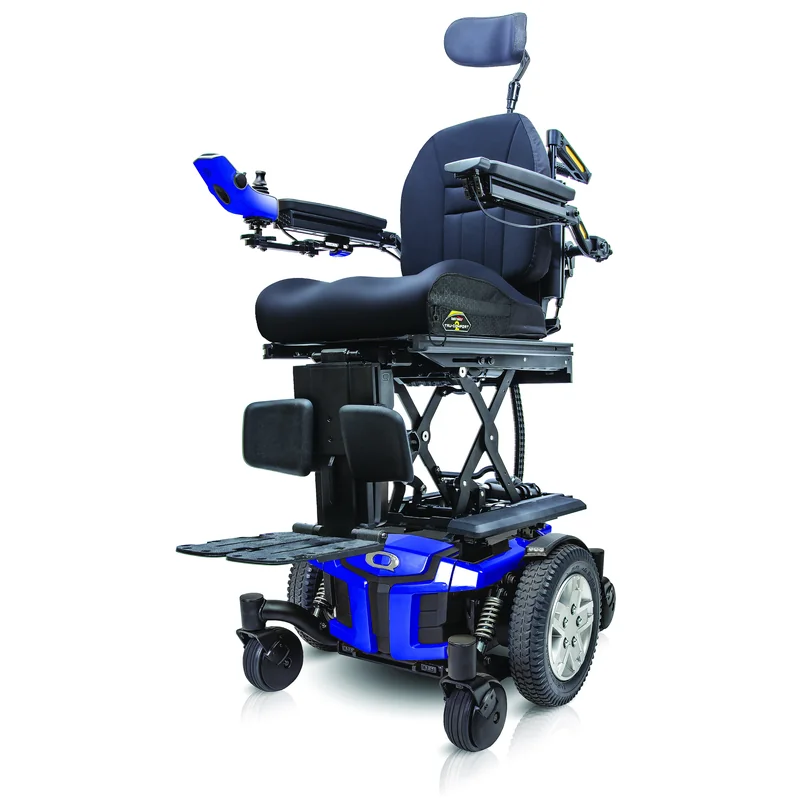
| Feature | Per Quantum Rehab |
|---|---|
| Base width | 26.25″ |
| Overall length | 35.6″ |
| Turning radius | 19.75″ |
| Weight capacity | 450 lb (400 lb with the iLevel power seat-height option) |
| Drive type | Mid-wheel drive |
| Seat elevate | Optional iLevel power adjustable seat height |
| Medicare code | Heavy Duty (K0850/K0851); Single Power HD (K0858); Multiple Power HD (K0862) |
Why it works indoors: Its 19.75-inch turning radius is the tightest of our 9 picks, and that comes from mid-wheel drive, which turns the chair close to its own center. That makes a big difference in a small bathroom or at the end of a hallway. Quantum offers optional power seating, including iLevel seat elevation, which helps at kitchen counters.
Pros
- Tightest turning radius of our 9 picks (19.75″)
- Supports riders up to 450 lb
- Optional iLevel power seat elevation for kitchen counters
Cons
- Widest base on our list (26.25″), so you’ll want roughly 28 to 29 inches of clear doorway width
- The iLevel option lowers the weight capacity to 400 lb
- A rehab-style chair, usually fitted through a supplier
Skip it if: Your narrowest doorway has less than about 28 inches of clear width.
Merits Velocity: Best for power tilt and recline in a compact base
Best for: Someone who needs to shift position during the day (tilt, recline, seat elevate) but lives in an average-size home.
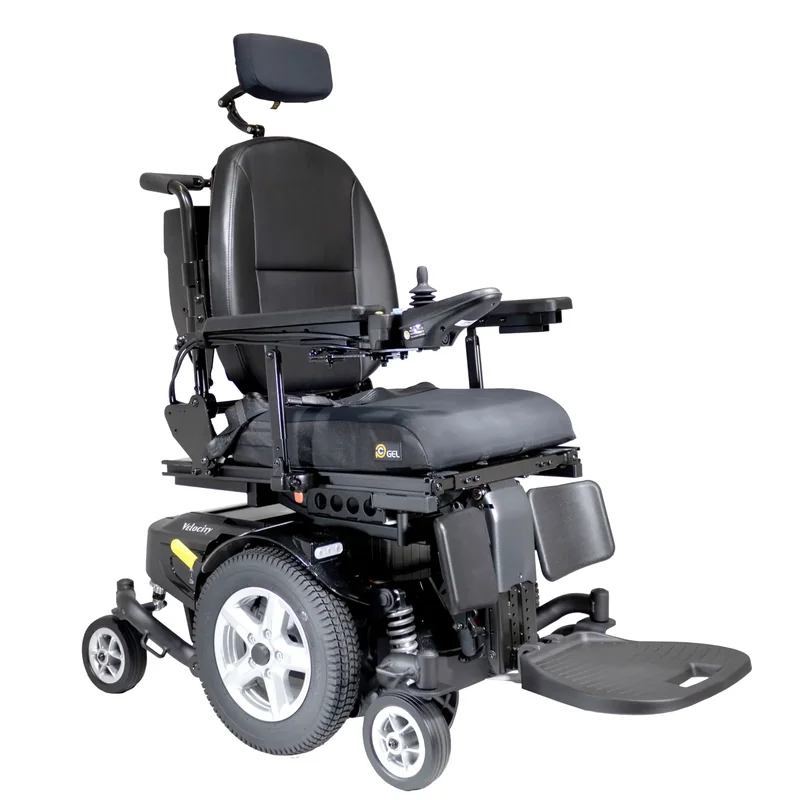
| Feature | Per Merits USA |
|---|---|
| Overall width | 24″ |
| Overall length | 36″ |
| Turning radius | 26″ |
| Weight capacity | 300 lb |
| Range | Up to 18 miles |
| Drive type | Mid-wheel drive |
| Seat-to-floor height | 16.5–19.5″; optional 12″ elevating seat |
| Medicare code | K0848/K0849/K0856/K0861 |
Why it works indoors: Merits calls out a narrow 24-inch base and a low seat-to-floor height, which help at tables and through standard interior doors. Power tilt and recline let the rider shift weight without a transfer, and the optional 12-inch seat elevation brings counters and cabinets within reach.
Pros
- Narrow 24″ base and low seat-to-floor height for tables and standard interior doors
- Power tilt and recline let the rider shift weight without a transfer
- Optional 12″ elevating seat brings counters and cabinets within reach
Cons
- 26″ turning radius is on the wide side (plan on about a 52-inch circle for a full turn)
- Power seating like this is usually set up through a supplier and a clinician
Skip it if: Your bathroom and kitchen can’t fit a roughly 52-inch turning circle.
Permobil F5 Corpus: Best for complex rehab and power seating
Best for: Someone with complex seating or positioning needs who wants a chair that does a lot: elevate, tilt forward, and handle the occasional outing.
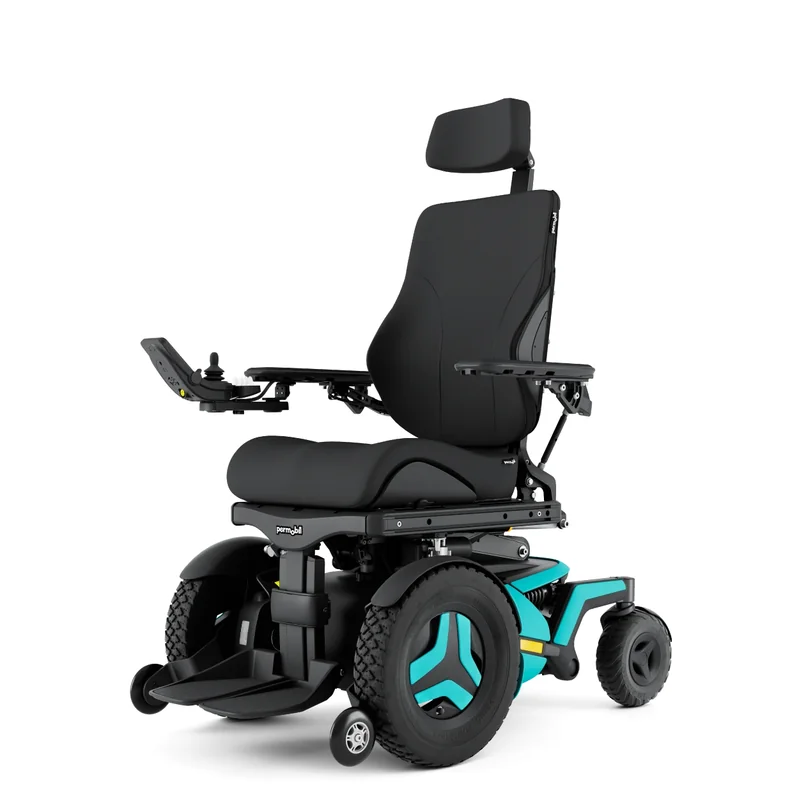
| Feature | Per Permobil |
|---|---|
| Base width | 25.5″ |
| Base length | 38″ without support wheels; 42″ with support wheels |
| Turning radius | 30″ |
| Weight capacity | 330 lb |
| Range | Up to 20 miles |
| Drive type | Front-wheel drive |
| Seat height / elevate | Seat-to-floor 17.5″, 18.5″ or 19.5″; up to 14″ ActiveHeight seat elevation; up to 45° ActiveReach forward tilt |
Why it works indoors: The 14 inches of ActiveHeight elevation and 45° ActiveReach forward tilt help with reaching kitchen cabinets, the stovetop and upper shelves. A low 17.5-inch seat-to-floor height helps at tables. Front-wheel drive lets the rider pull up close to counters and roll over small thresholds.
Pros
- Up to 14″ of seat elevation and 45° forward tilt for cabinets, the stovetop and upper shelves
- Low 17.5″ seat-to-floor height helps at tables
- Front-wheel drive pulls up close to counters and rolls over small thresholds
Cons
- 30″ turning radius is the widest on our list, so plan on about a 60-inch circle to turn all the way around
- The 25.5″ base needs roughly 28 inches of clear doorway width
- A complex rehab chair, usually fitted through a seating clinic and a supplier, who measure the rider and set up the seating. Exact numbers can vary with the seating setup, so check them with your supplier
Skip it if: The rider doesn’t need complex seating or power positioning, or your bathroom can’t fit a roughly 60-inch turning circle.
Pride Jazzy Elite ES: Best standard Medicare-coded everyday chair
Best for: A rider who needs a straightforward everyday power chair for the home and wants one with standard Group 2 Medicare codes.
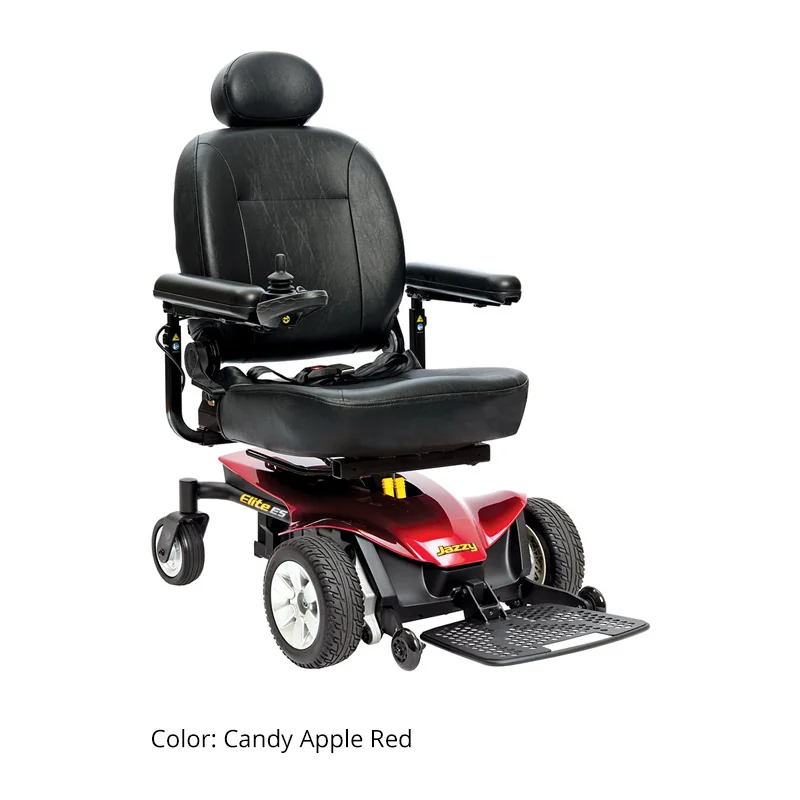
| Feature | Per Pride Mobility |
|---|---|
| Width | 22.75″ |
| Length | 34.75″ (41″ with footplate) |
| Turning radius | 24.75″ |
| Weight capacity | 300 lb |
| Range | Up to 15 miles |
| Drive type | Front-wheel drive |
| Medicare code | Group 2 Standard (K0822/K0823) |
Why it works indoors: At 22.75 inches wide, it clears most standard interior doorways with room to spare. Front-wheel drive helps it pull close to tables and get over small thresholds. Pride’s Group 2 standard codes make it a natural fit for families going the Medicare route.
Pros
- 22.75″ wide, so it clears most standard interior doorways with room to spare
- Front-wheel drive pulls close to tables and gets over small thresholds
- Group 2 standard Medicare codes (K0822/K0823)
Cons
- 24.75″ turning radius needs about a 50-inch circle to turn all the way around, so a small bathroom may need a three-point turn
- Length grows to 41″ with the footplate, which matters in small elevators
Skip it if: You need the tightest possible turn in a very small bathroom.
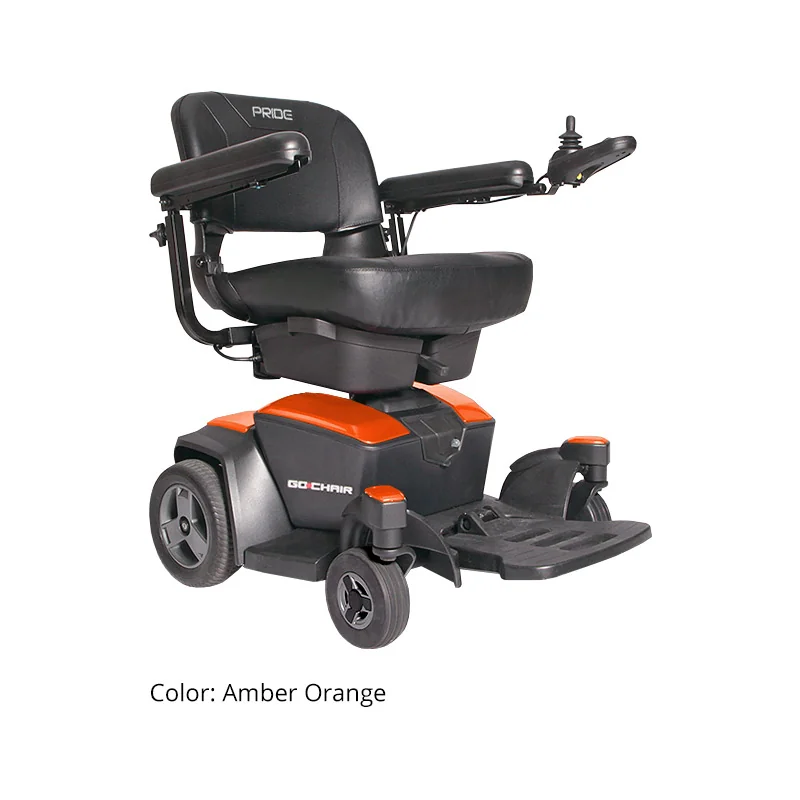
Pride Jazzy Go Chair: Best for compact homes and short elevators
Best for: Someone in a small apartment or condo who needs a short, narrow chair, or a family that wants one that comes apart for the car.
| Feature | Per Pride Mobility |
|---|---|
| Width | 22.5″ |
| Length | 28.5″ without front rigging; 33″ with front rigging |
| Turning radius | 25.5″ |
| Weight capacity | 300 lb |
| Range | Up to 11.2 miles |
| Medicare code | K0899 (Pride notes this means not coded by DME PDAC or does not meet criteria) |
Why it works indoors: It’s the narrowest of our top five at 22.5 inches and the shortest at 28.5 inches without front rigging, so it’s a good fit in older condo elevators, galley kitchens and tight entry halls. The compact folding seat is a plus when the chair has to ride in a car now and then.
Pros
- Narrowest of our top five (22.5″) and shortest (28.5″ without front rigging)
- Fits older condo elevators, galley kitchens and tight entry halls
- Compact folding seat for the occasional car trip
Cons
- 25.5″ turning radius is wider than its small size suggests, so turning around in a tiny bathroom can take a couple of moves
- Range is up to 11.2 miles, fine for the home and short outings
- Pride lists the K0899 code, so plan on paying out of pocket
Skip it if: You’re counting on Medicare to cover the chair.
In Miami-Dade or Broward? See if you qualify for a power wheelchair
Take our free 60-second assessment. If it looks like a fit, a local mobility specialist can explain Medicare or insurance coverage and next steps, at no cost and with no obligation.
Self-pay picks (usually not covered by insurance)
These four chairs are usually bought out of pocket rather than through Medicare or insurance. Most have no standard Medicare code from the manufacturer, or a code that rarely leads to coverage. If you’re hoping for coverage, ask a Medicare-enrolled supplier before you buy. The upside: no paperwork, and you choose the chair yourself.
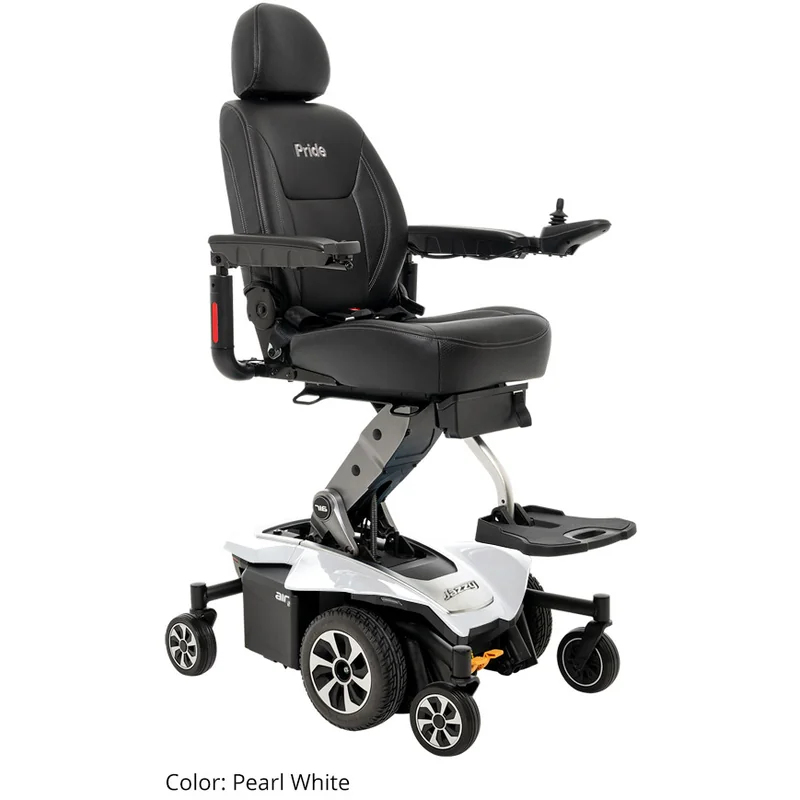
Pride Jazzy Air 2: Best seat elevate for the kitchen
Best for: Someone who wants to reach counters and cabinets and talk to family at eye level.
| Feature | Per Pride Mobility |
|---|---|
| Width | 23.25″ |
| Length | 33.21″ (42″ with footplate) |
| Turning radius | 24.25″ |
| Weight capacity | 300 lb |
| Range | Up to 15 miles at 300 lb; up to 16.6 miles at 220 lb |
| Drive type | Mid-wheel drive |
| Seat elevate | 12″ of power seat elevation in 11 seconds; drives up to 4 mph while elevated |
| Medicare code | K0899 (not coded by DME PDAC or does not meet criteria, per Pride) |
Why it works indoors: The 12-inch power seat lift is the reason to pick this chair: it puts kitchen counters, upper cabinets and the microwave within reach, and it can still drive while raised. Mid-wheel drive and a 23.25-inch width suit most homes.
Pros
- 12″ power seat lift puts counters, upper cabinets and the microwave within reach
- Can still drive while raised (up to 4 mph)
- Mid-wheel drive and a 23.25″ width suit most homes
Cons
- 42″ long with the footplate, so measure small elevators
- 24.25″ turning radius needs about a 49-inch circle for a full turn
Skip it if: Your elevator or hallway jog is too short for a 42-inch chair.
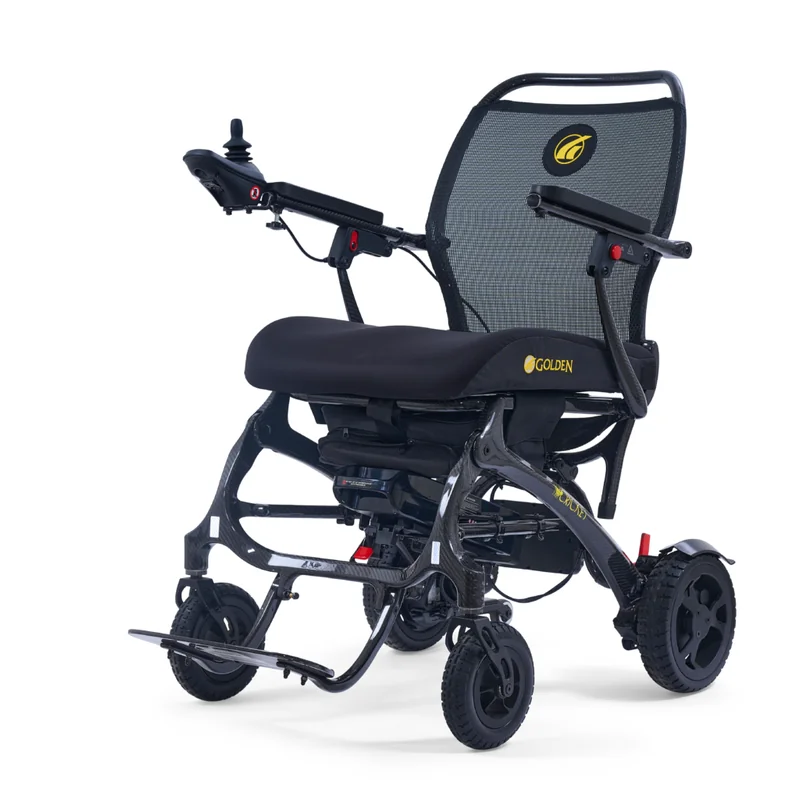
Golden Cricket: Best lightweight carbon-fiber chair
Best for: Someone who wants one chair that’s light enough to lift but still slim enough for the house.
| Feature | Per Golden Technologies |
|---|---|
| Width | 22.5″ |
| Length | 36.6″ |
| Turning radius | 22″ |
| Weight capacity | 300 lb |
| Range | Up to 9.3 miles |
Why it works indoors: At 22.5 inches wide with a 22-inch turning radius, it’s one of the narrowest and nimblest chairs here. Golden says the carbon-fiber frame weighs as little as 33 lb, which makes it easy to move between home and car.
Pros
- 22.5″ wide with a 22″ turning radius, one of the narrowest and nimblest chairs here
- Carbon-fiber frame weighs as little as 33 lb, per Golden
Cons
- Range is up to 9.3 miles, fine indoors but modest for long outings
- At 36.6″, it’s longer than the Go Chair, so check small elevators
Skip it if: The rider wants long outings on a single charge.
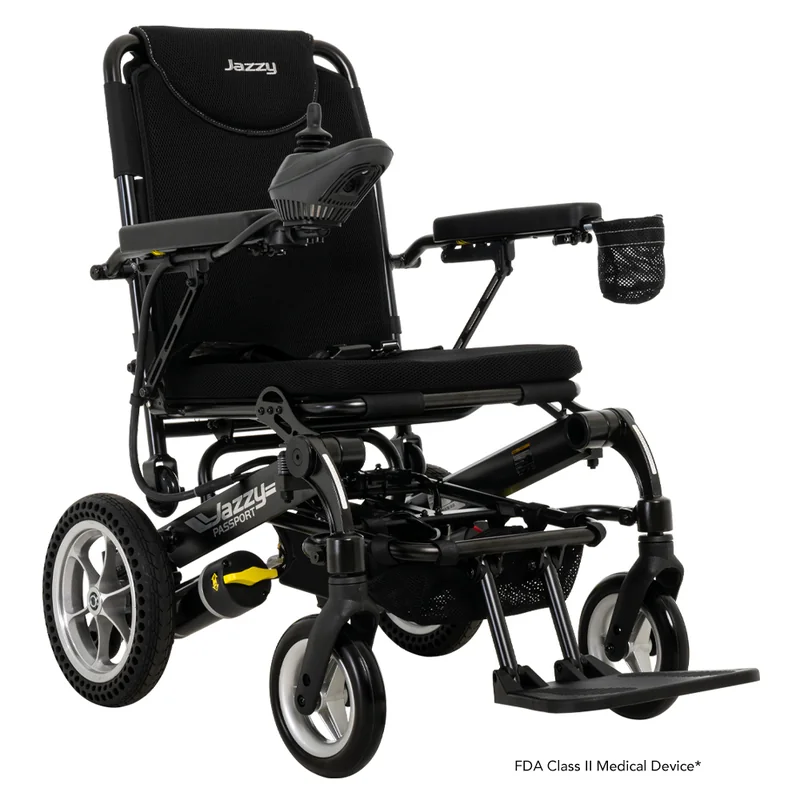
Pride Jazzy Passport: Best for lighter riders who want a folding chair
Best for: A lighter rider (up to 250 lb) who mostly drives around the house and wants a chair that folds.
| Feature | Per Pride Mobility |
|---|---|
| Width | 23.5″ |
| Length | 40″ (with footplate) |
| Turning radius | 24.25″ |
| Weight capacity | 250 lb |
| Range | Up to 5 miles (220 lb rider, 10.4AH battery) |
| Drive type | Rear-wheel drive |
| Medicare code | K0899 (not coded by DME PDAC or does not meet criteria, per Pride) |
Why it works indoors: It’s 23.5 inches wide, which clears most interior doors, and it folds for storage or a car trunk. For a rider who mostly moves between rooms, the short range rarely matters.
Pros
- 23.5″ wide, which clears most interior doors
- Folds for storage or a car trunk
Cons
- 250 lb weight limit, the lowest here
- Range is up to 5 miles
- Rear-wheel drive and a 40″ length with the footplate make tight bathrooms harder
Skip it if: The rider is over 250 lb, or your bathroom is tight.
Merits EZ-GO: Best short travel chair for small spaces
Best for: Someone who wants a short, simple chair for an apartment that also comes apart for the car.
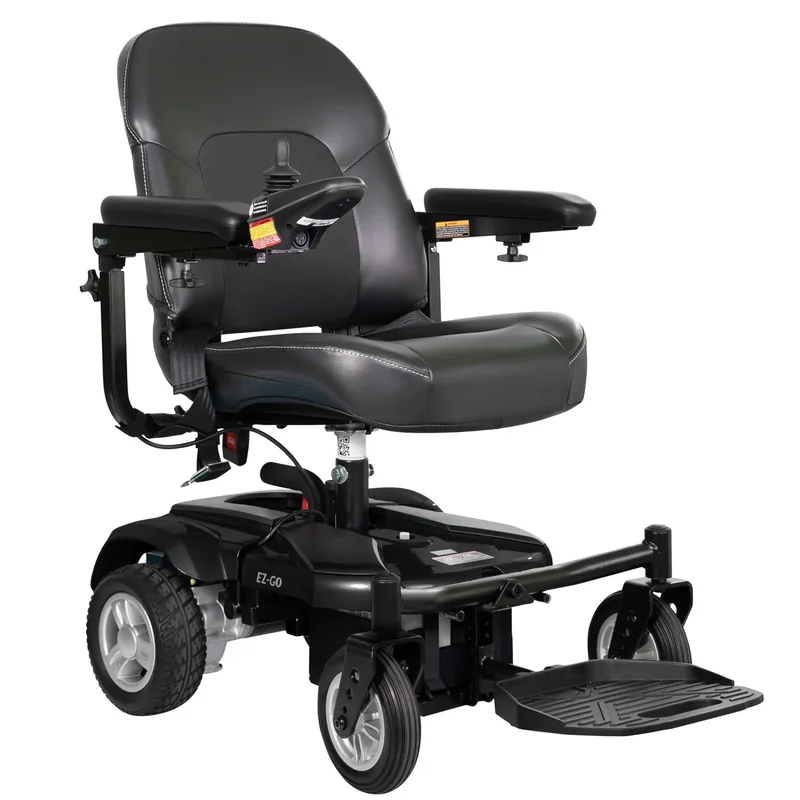
| Feature | Per Merits USA |
|---|---|
| Overall width | 25″ |
| Overall length | 31.5″ |
| Turning radius | 22.25″ |
| Weight capacity | 300 lb |
| Range | Up to 12 miles |
| Drive type | Rear-wheel drive |
| Medicare code | K0814 (listed by Merits) |
Why it works indoors: At 31.5 inches long with a 22.25-inch turning radius, it’s short and turns well, which helps in small elevators and entry halls. Merits says it’s built for travel, with quick-connect assembly.
Pros
- 31.5″ long with a 22.25″ turning radius, so it fits small elevators and entry halls
- Built for travel, with quick-connect assembly, per Merits
Cons
- At 25″ wide, it’s one of the wider chairs here, so it needs roughly 27 to 28 inches of clear doorway width
- Merits lists a Group 1 code (K0814), but chairs like this are usually bought out of pocket. Ask a supplier if you’re hoping for coverage
Skip it if: Your narrowest doorway has less than about 27 inches of clear width.
Mid-wheel vs. rear-wheel vs. front-wheel drive for indoor use
Where the drive wheels sit is one of the biggest things that decides how a chair behaves inside a home.
- Mid-wheel (center-wheel) drive. The drive wheels sit under the rider, with small wheels in front and behind. The chair spins close to its own center, so it usually has the tightest turning radius. For most indoor use, this is the drive type to start with. The trade-off: on steep ramps or bumpy ground, the front or back wheels can rock, so look for good suspension if the chair also goes outside.
- Rear-wheel drive. The drive wheels are at the back, like a car. It tracks straight and feels familiar, and many folding and compact chairs use it. It usually needs more room to turn, so it suits homes with wider hallways and open floor plans.
- Front-wheel drive. The drive wheels are at the front, which can help with getting over small thresholds and getting close to tables and counters. It can feel less steady at higher speeds, and it often needs more room to turn than mid-wheel drive.
If your home has narrow halls and small bathrooms, mid-wheel drive is usually the most forgiving. If your home is roomy and the chair also needs to go outdoors a lot, rear- or front-wheel drive can make sense.
Indoor-only vs. indoor/outdoor: which do you need?
Be honest about where the chair will actually go. A chair built mainly for indoor use is usually narrower, shorter and turns tighter, but it has smaller wheels, lower ground clearance and less range. An indoor/outdoor chair handles sidewalks, driveways, lanais and pool decks better, but it is often a bit wider and longer.
A simple way to decide: if the chair will spend most of its day inside, with short trips to the mailbox or the car, choose for the house first. If the rider wants regular outings around the neighborhood, lean toward a pick above with more range and bigger tires, and double-check that it still clears your narrowest doorway. For chairs that fold for the car or for travel, see our best electric wheelchairs guide.
Carpet, rugs and thresholds: what actually gets stuck
Most power wheelchairs can drive on carpet, but floors still make a difference.
- Low-pile carpet is usually fine. Thick, plush carpet adds drag, makes turning harder and uses more battery.
- Loose area rugs are a common trouble spot. Small wheels can catch the edge and bunch the rug up. Tape the edges down, use non-slip pads, or remove rugs along the main path.
- Thresholds between rooms, like tile to carpet or a raised bathroom saddle, can stop small front wheels. A small rubber threshold ramp is an easy, low-cost fix.
- Sliding glass door tracks (very common in Florida homes) can be tricky. A threshold ramp made for door tracks helps the chair roll over smoothly onto the lanai or balcony.
When you compare chairs, look at the wheel size and drive type. Larger caster wheels and good suspension generally roll over transitions more easily.
The rooms that decide the chair
Bathroom
The bathroom is usually the smallest room and the narrowest door, so measure it first. Think about where the chair will park for a transfer to the toilet or a shower bench, and whether the rider can turn around inside or will need to back out. Swing-out or removable footrests can save precious inches.
Kitchen
In the kitchen, seat height matters as much as width. A chair with power seat elevate raises the rider so they can reach counters, upper cabinets and the microwave, and talk with family at eye level. Also check the gap between the counter and the table or island.
Bedroom
Leave room beside the bed for the chair to pull up parallel for transfers. Matching the seat height to the bed height makes sliding across easier. Clear a path so the rider can get to the bathroom at night without tight turns in the dark.
Small apartments and condos
Many South Florida condos and high-rises have older, smaller elevators, narrow entry halls and tight galley kitchens. Measure the elevator door and its inside depth, plus the turn from the elevator into the hallway and through your front door. In a small elevator, a chair’s length can matter more than its width. A shorter, mid-wheel drive chair is often the easiest fit.
Medicare and home use: the in-home rule in plain English
Here’s the part many families don’t expect: Medicare Part B covers a power wheelchair only when it’s medically necessary for use inside your home. That makes an indoor chair and Medicare a natural fit, because Medicare is looking at the same thing you are: how the chair will help inside the house.
In plain English, Medicare’s rules (laid out in its power mobility device policy, LCD L33789) ask questions like these:
- Does a mobility problem make it hard to do everyday tasks at home? Medicare calls these “mobility-related activities of daily living”: things like getting to the bathroom, dressing, bathing and getting around the kitchen.
- Would a cane or walker be enough? If yes, a power chair won’t qualify.
- Can the person use a manual wheelchair safely? If they could, Medicare would usually cover that instead. A power chair is for people who can’t self-propel a manual chair well enough at home.
- Can the person drive a power chair safely, and are they willing to use it at home?
- Does the home work for the chair? Medicare wants the home to have enough room between rooms, space to maneuver and floor surfaces the chair can handle. This is exactly why measuring doorways and turning space matters.
What the process usually looks like:
- A face-to-face visit with your doctor or other treating provider, who documents the mobility problem.
- A written order from that provider.
- The chair comes from a Medicare-enrolled supplier, who often checks the home. Many power chairs also need prior authorization before delivery.
- After the Part B deductible, you generally pay 20% of the Medicare-approved amount. Medicare Advantage plans and Medicaid may have their own rules.
The HCPCS codes in the picks above (such as K0822/K0823 on the Jazzy Elite ES, or the rehab codes on the Q6 Edge HD and Velocity) are the billing codes suppliers use. A code alone doesn’t guarantee coverage; your health and your home decide that. Pride lists K0899 for the Go Chair, Jazzy Air 2 and Passport, which means the chair isn’t coded by Medicare’s coding contractor or doesn’t meet its criteria. Chairs like these are usually bought out of pocket.
Complex rehab chairs like the Permobil F5 Corpus, and chairs with power tilt, recline or elevate like the Merits Velocity and Q6 Edge HD, are usually fitted through a seating clinic and a supplier. A therapist measures the rider, and the supplier handles the paperwork. If you’re in Miami-Dade or Broward, our free assessment can help you see whether you may qualify and point you to next steps.
National Medicare-enrolled suppliers include:
Many local suppliers work with Medicare too.
Power Mobility Guide is independent and isn’t affiliated with these suppliers.
For the official details, see Medicare.gov’s wheelchairs and scooters page.
In Miami-Dade or Broward? See if you qualify for a power wheelchair
Take our free 60-second assessment. If it looks like a fit, a local mobility specialist can explain Medicare or insurance coverage and next steps, at no cost and with no obligation.
Frequently asked questions
What is the best power wheelchair for indoor use?
For most homes, a compact mid-wheel drive chair is the best place to start, because it turns in the smallest space. Of our picks, the Quantum Q6 Edge HD has the tightest turning radius (19.75 inches), the Pride Jazzy Go Chair and Golden Cricket are the narrowest (22.5 inches), and the Pride Jazzy Elite ES is a standard Medicare-coded everyday chair. The right chair for you depends on your narrowest doorway and the open floor in your bathroom and kitchen, so measure first.
What is the smallest power wheelchair?
Of our 9 picks, the Pride Jazzy Go Chair and Golden Cricket are the narrowest at 22.5 inches. The Go Chair is also the shortest, at 28.5 inches without front rigging. Smaller chairs often trade away some range, seat size or outdoor ability, so check that the rest of the product details still fit the rider.
How wide does a doorway need to be for a power wheelchair?
Measure the doorway’s clear width with the door fully open, then subtract 2 to 3 inches. Pick a chair no wider than that number. If you’re close, offset (swing-clear) hinges can often gain an inch or two.
What does turning radius mean on a power wheelchair?
It’s how much room the chair needs to turn. To turn all the way around, plan on a clear circle about twice the listed turning radius. Mid-wheel drive chairs usually have the tightest turning radius. On our list, that’s the Quantum Q6 Edge HD at 19.75 inches.
Can power wheelchairs go on carpet?
Yes, most can. Low-pile carpet is usually easy. Thick carpet adds drag and uses more battery, and loose rugs can catch small wheels. Taping rug edges and adding threshold ramps between rooms helps a lot.
How do you qualify for a power wheelchair?
For Medicare, you need a mobility problem that makes everyday tasks at home, like getting to the bathroom or dressing, hard to do, one that a cane, walker or manual wheelchair can’t solve. You’ll need a face-to-face visit and a written order from your provider, your home must have room for the chair, and the chair must come from a Medicare-enrolled supplier. Private insurance and Medicare Advantage plans may have their own steps.
Does Medicare cover a power wheelchair for indoor use?
Yes, in fact Medicare Part B only covers power wheelchairs that are medically necessary for use in the home. If you qualify, you generally pay 20% of the Medicare-approved amount after the Part B deductible.
This guide is for general information and isn’t medical advice. Talk with your healthcare provider about which mobility device and seating setup is right for you.