We independently select all products and services. While we earn a commission from partner links, commissions do not affect our opinions or evaluations.
If you’re shopping for an electric wheelchair for yourself or for a parent, the product details can feel like a foreign language. Range, watt-hours, turning radius and Medicare codes all matter, and many “best of” lists skip them or copy them wrong.
So we did the slow part. We read the manufacturer’s product sheet or product page for every chair below and wrote down what the manufacturer actually says. Where two of a manufacturer’s own pages disagree, we tell you. This is a detail-by-detail comparison, built to help you narrow the list down.
This guide covers joystick-driven power wheelchairs only, not mobility scooters.
Shopping for a chair that mostly stays indoors? See our best power wheelchairs for indoor use.
The short answer: For most people who want a chair that folds and travels, the Pride Jazzy Carbon is our best electric wheelchair overall. On a tight budget, the Vive Health Airframe is our budget pick, if the rider is 225 lb or under.
Quick picks
| Pick | Best for | What stands out |
|---|---|---|
| Pride Jazzy Carbon | Best overall (travel) | 43.6 lb with battery; 288 Wh battery |
| Journey Air Elite | Lightest to lift | 29 lb with battery |
| ComfyGo Majestic IQ-9000 | Long-range folding chair | Up to 19 mi; two 180 Wh batteries |
| EZ Lite Cruiser Deluxe DX12 | Easiest for a caregiver to load | Splits into 3 pieces; heaviest is 37 lb |
| Forcemech Navigator PRO | Outdoor use | 3.5″ ground clearance, 4-point suspension |
| Vive Health Airframe | Budget | 44 lb with battery; folds |
| Pride Jazzy 600 ES | Small homes and tight hallways | 20.5″ turning radius |
| Golden Compass Sport GP605 | Longest range (full-size) | 24 mi standard, up to 34 mi with optional batteries |
| Pride Jazzy 1450 | Heavy-duty / bariatric | 600 lb user capacity |
In Miami-Dade or Broward? See if you qualify for a power wheelchair
Take our free 60-second assessment. If it looks like a fit, a local mobility specialist can explain Medicare or insurance coverage and next steps, at no cost and with no obligation.
How we chose (and how we checked the details)
We started with chairs that show up most often at US retailers, then narrowed to 9 that cover the most common needs: travel, light weight, range, outdoor use, small homes, budget and heavy-duty.
For each chair, we:
- Opened the manufacturer’s product page or sheet (or, for Forcemech, a retailer page quoting Forcemech’s details). Every link is in the Sources section.
- Recorded weight with the battery, not just the lighter “frame only” number many listings lead with.
- Calculated battery watt-hours (volts × amp-hours) where the manufacturer gave those numbers, so you can compare against the FAA’s 300 Wh limit for lithium-ion mobility device batteries.
- Noted the Medicare (HCPCS) code where the manufacturer or supplier published one.
- Flagged conflicts instead of picking the nicer number. For example, EZ Lite Cruiser lists the DX12 at 305 lb on its product page but 330 lb on its compare page. Forcemech’s product table says 400 lb, while its warranty page says 397 lb. Journey’s product page says “up to 10 miles” of range, and the compare table on the same page says 9.3.
Real-world range and comfort depend on the rider, the terrain and the seating setup. For any seating or positioning needs (pressure sores, posture, trunk support), please talk with a doctor, physical therapist (PT) or occupational therapist (OT) before you buy.
Prices change often, so check the retailer links for current pricing.
The best electric wheelchairs of 2026
Pride Jazzy Carbon: Best overall for travel
Best for: Someone who wants a real Pride chair that folds, fits in a car trunk and can go on a plane.
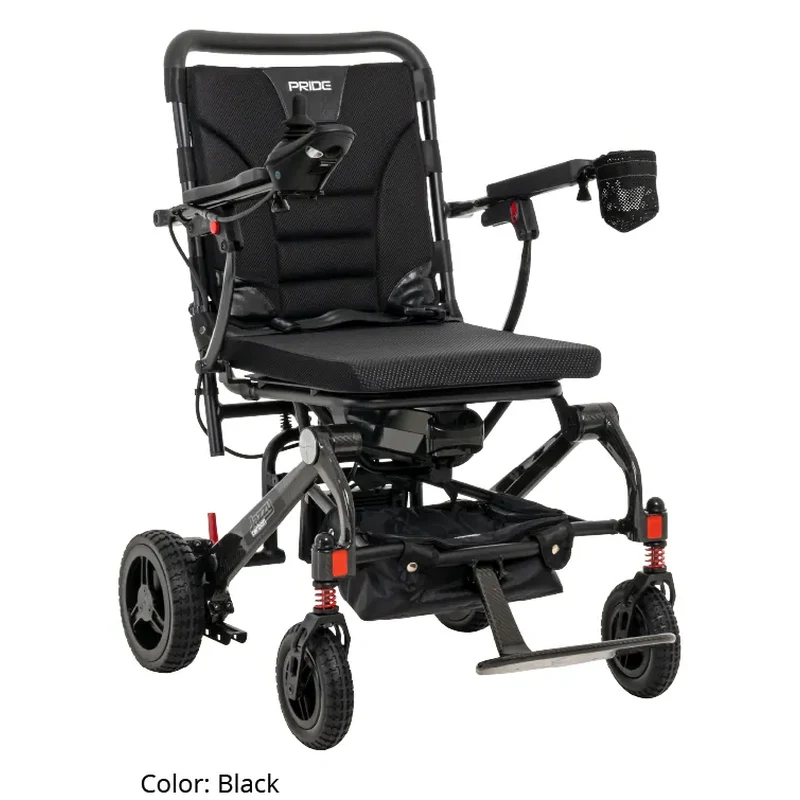
| Feature | Per Pride’s product sheet |
|---|---|
| Weight with battery | 43.6 lb (39 lb without) |
| Max user weight | 300 lb |
| Range | Up to 9.3 mi |
| Battery | 24V 12Ah = 288 Wh (under the FAA’s 300 Wh limit) |
| Medicare code | See manufacturer’s site |
The Jazzy Carbon uses a carbon-fiber frame and rear-wheel drive, and it folds. It pairs a 300 lb capacity with an under-45 lb weight, from a large brand with a wide dealer network. The battery works out to 288 Wh, just under the FAA’s 300 Wh cap. Pride still tells owners to check with their airline before flying, and you should too.
Pros
- Light for its 300 lb capacity
- Battery comes in under the FAA’s 300 Wh limit
- Sold and serviced through Pride’s dealer network
Cons
- Range of up to 9.3 mi is modest, so it’s an errands-and-travel chair rather than an all-day outdoor one
Skip it if: You need long range for all-day outings, or you weigh more than 300 lb.
Journey Air Elite: Lightest to lift
Best for: A lighter rider, or a caregiver who has to lift the chair into a car every day.
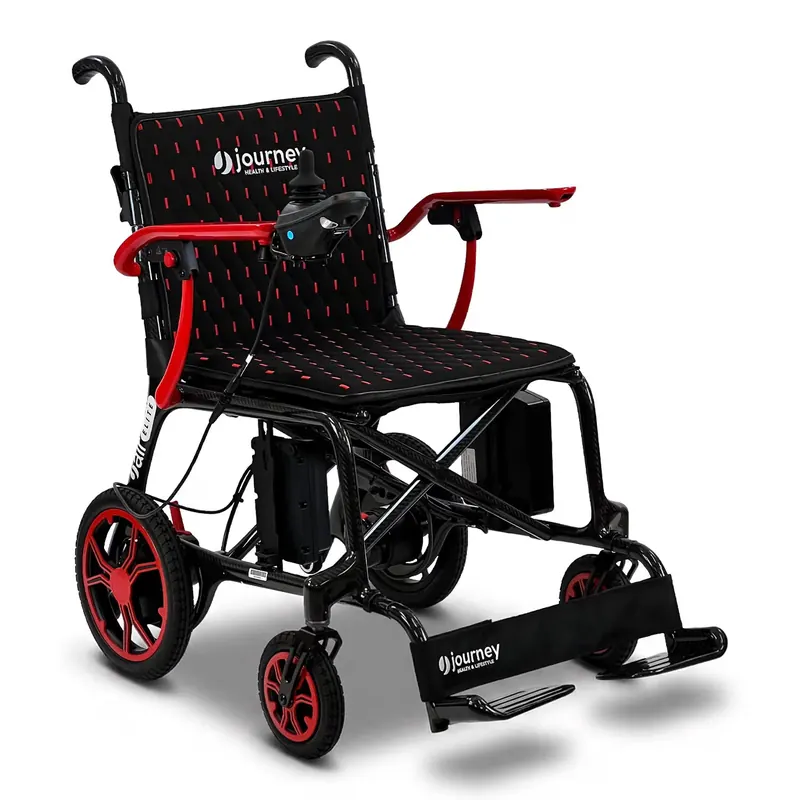
| Feature | Per Journey’s product page |
|---|---|
| Weight with battery | 29 lb (26 lb without) |
| Max user weight | 240 lb |
| Range | “Up to 10 mi” (the same page’s compare table says 9.3 mi) |
| Battery | Journey calls it “FAA compliant”; see manufacturer’s site for Wh |
| Medicare code | None. Journey sells direct and doesn’t process insurance |
At 29 lb with the battery, the Air Elite is the lightest chair on our list. Lifting 29 lb instead of 44 lb into a trunk several times a week makes a real difference for an older spouse or caregiver. The trade-off is a 240 lb weight limit. Journey sells direct, doesn’t handle insurance, and lists the chair as HSA/FSA eligible.
Pros
- Lightest chair here
- Folds compactly for cars and travel
- HSA/FSA eligible, per Journey
Cons
- 240 lb maximum user weight
- Range figure is listed two ways (10 mi vs 9.3 mi), so plan around the lower number
Skip it if: The rider is over 240 lb, or you’re hoping to use Medicare. (If you need more capacity, Journey’s Air Elite Max is rated for 330 lb and up to 19.8 mi, per Journey’s compare table.)
ComfyGo Majestic IQ-9000: Best long-range folding chair
Best for: Someone who wants a folding, portable electric wheelchair that can cover a full day out, plus a remote so a caregiver can drive it.
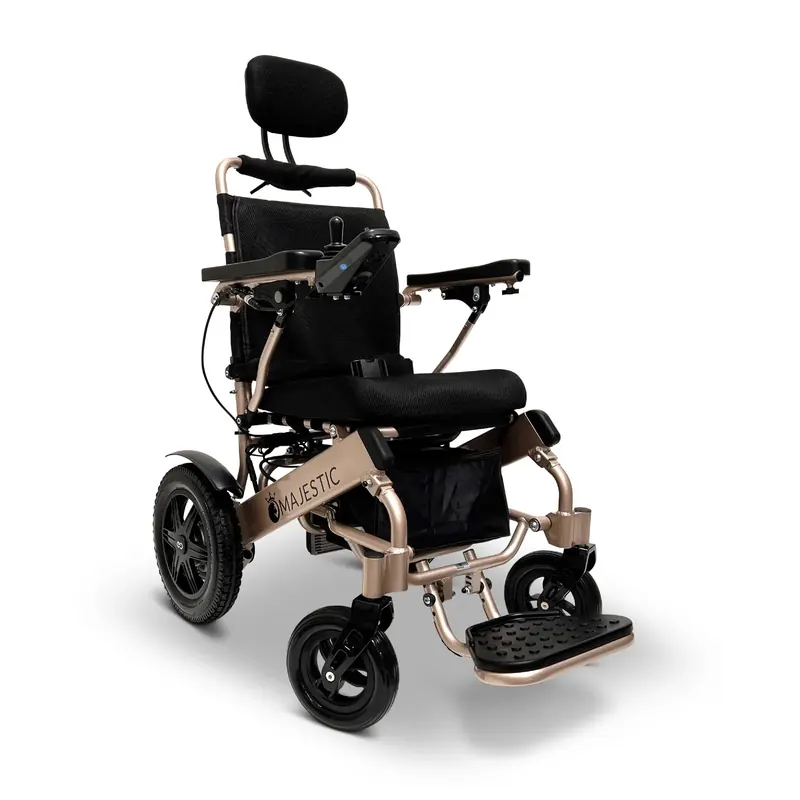
| Feature | Per ComfyGo’s product page |
|---|---|
| Weight with batteries | About 56 lb (49 lb frame + 3.5 lb per battery, by our math). The auto-recline (AR) model adds 3 lb |
| Max user weight | 330 lb (310 lb for the AR model) |
| Range | Up to 19 mi |
| Battery | Two 180 Wh batteries; ComfyGo says “airline and cruise approved” |
| Medicare code | See manufacturer’s site |
The IQ-9000 runs on two batteries, which is how it reaches a claimed 19 miles while still folding. Each battery is 180 Wh, under the 300 Wh per-battery cap. The remote lets a companion steer when the rider is tired. The auto-recline version is a little heavier, with a slightly lower weight limit.
Pros
- Up to 19 mi of claimed range, about double many folding chairs
- 330 lb capacity on the standard model
- Caregiver remote control
Cons
- Heavier to lift than the Jazzy Carbon or Journey
Skip it if: Whoever lifts the chair can’t safely manage a load in the mid-50s (lb). Note that the batteries come out, so you’re not lifting it all at once.
EZ Lite Cruiser Deluxe DX12: Easiest for a caregiver to load
Best for: Families where the person loading the car can’t lift 40+ lb in one go.
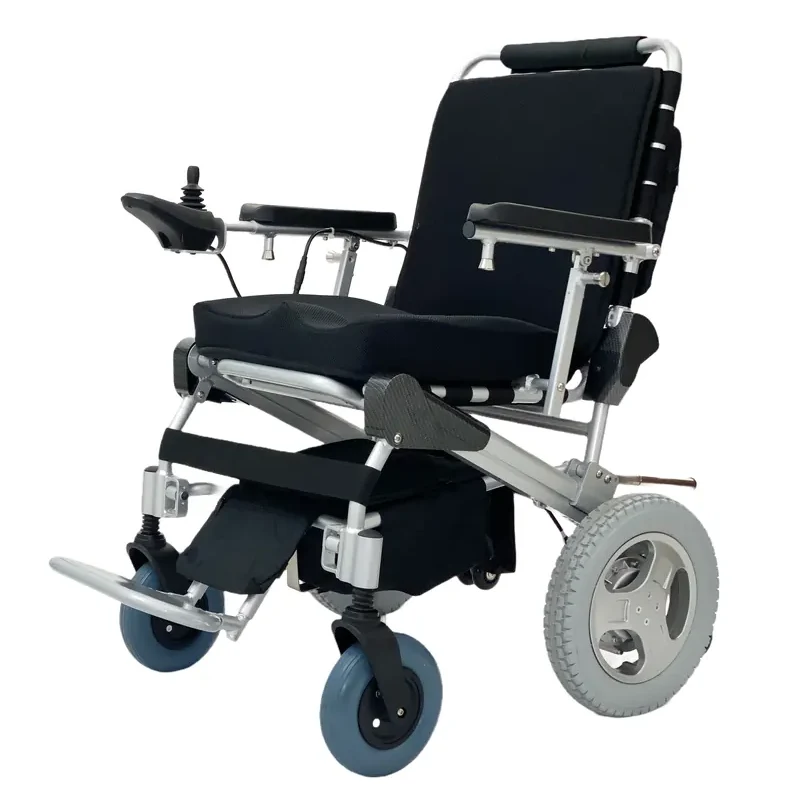
| Feature | Per EZ Lite Cruiser |
|---|---|
| Weight | 62 lb total, in 3 pieces: a 37 lb frame plus two motor/wheel units of about 13 lb each |
| Max user weight | Up to 330 lb per the manufacturer’s compare page (the product page says 305 lb, so check before you buy) |
| Range | 10 mi with the 10Ah battery; 15 mi with the 15Ah battery |
| Battery | 10Ah = 240 Wh (under the FAA limit). 15Ah = 360 Wh, over the FAA’s 300 Wh limit |
| Medicare code | See manufacturer’s site |
The DX12 is heavier in total than most folding chairs here, but it comes apart. No single piece weighs more than 37 lb, which is why it can be easier to load than a lighter chair that stays in one piece. Pay attention to the battery choice: the 15Ah battery adds range, but at 360 Wh it’s over the FAA’s limit for flying. If air travel is in the plan, the 10Ah battery is the one that fits the rule.
Pros
- Splits into pieces of 37 lb or less
- Two battery options
- Sold direct and through an Amazon brand store
Cons
- The manufacturer’s own pages give two weight limits (305 vs 330 lb)
- The longer-range 15Ah battery isn’t flight-friendly
Skip it if: The rider is near 300 lb (check the limit with EZ Lite first), or you want the long-range battery and plan to fly.
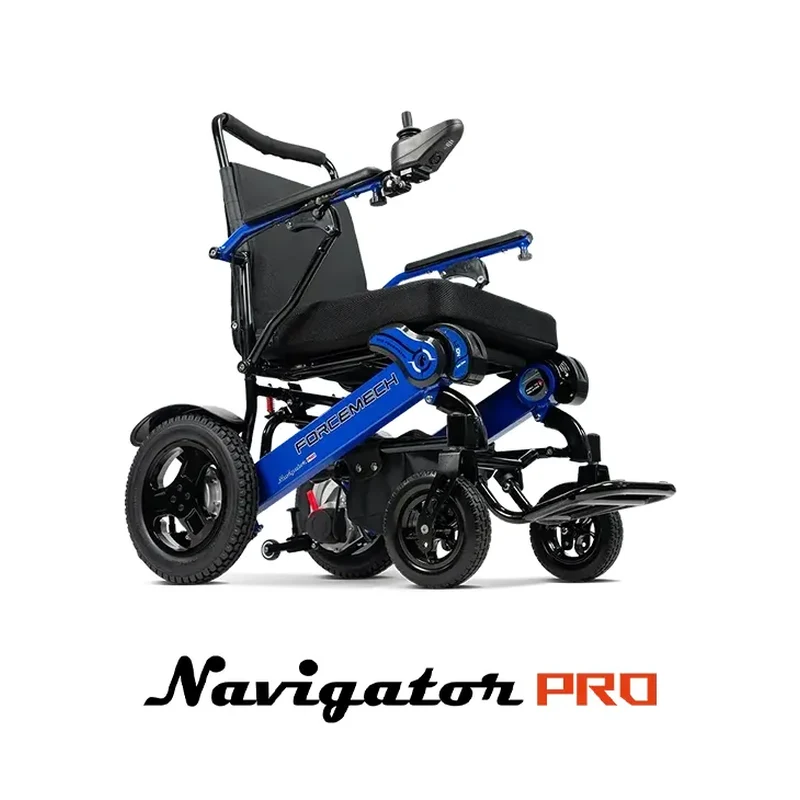
Forcemech Navigator PRO: Best power wheelchair for outdoor use
Best for: Riders who deal with grass, gravel, curbs and bumpy sidewalks but still want a chair that folds.
| Feature | Per Hieline, quoting Forcemech |
|---|---|
| Weight with batteries | 60 lb |
| Max user weight | 400 lb on the product table (Forcemech’s warranty page says 397 lb) |
| Range | Up to 18 mi (measured at 150 lb on flat ground) |
| Battery | Marketed as “FAA air travel and cruise ready”; see manufacturer’s site for Wh |
| Medicare code | See manufacturer’s site |
The Navigator PRO adds four-point suspension, 3.5 inches of ground clearance and a 12° climbing rating, which is why it’s our pick for the best power wheelchair for outdoor use. It also has the highest weight rating of any folding chair here. Its 18-mile range was measured with a 150 lb rider on flat ground, so expect less with a heavier rider or hills.
Pros
- Suspension and 3.5″ ground clearance for rougher ground
- Rated up to about 400 lb
- 12° climbing rating
Cons
- Ask Forcemech (and your airline) for the battery’s watt-hours before flying
- At 60 lb, it’s a heavier lift than travel-first chairs
Skip it if: You mostly stay indoors, or you need the lightest possible chair for lifting.
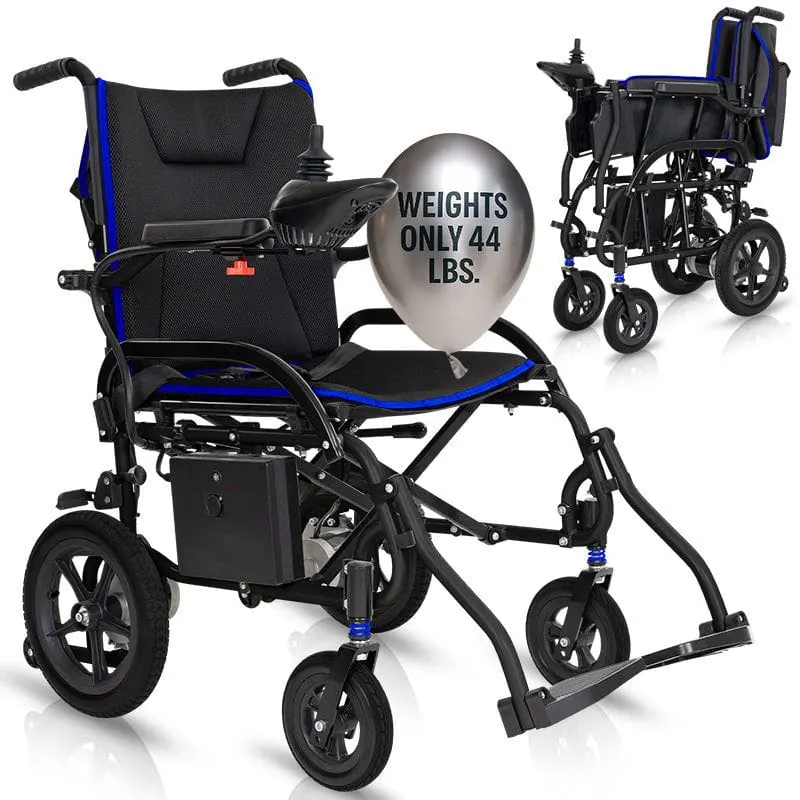
Vive Health Airframe: Best budget electric wheelchair
Best for: A lighter rider who needs a basic folding power chair for short trips on a tight budget.
| Feature | Per Vive’s product page |
|---|---|
| Weight with battery | 44 lb |
| Max user weight | 225 lb |
| Range | Up to 9 mi |
| Battery | 24V 12Ah = 288 Wh by our calculation; Vive’s page doesn’t state airline approval |
| Medicare code | See manufacturer’s site |
The Airframe is our budget pick. It weighs about the same as the Jazzy Carbon, but with a 225 lb limit and shorter range. The battery’s numbers work out to 288 Wh, under the FAA’s cap, but Vive doesn’t say the chair is airline approved, so call your airline before you book.
Pros
- 44 lb with battery, folding
- Battery math comes in under 300 Wh
Cons
- Lowest weight capacity here (225 lb)
- Airline approval isn’t stated by the manufacturer
Skip it if: The rider is over 225 lb, or the chair will be used for long days out.
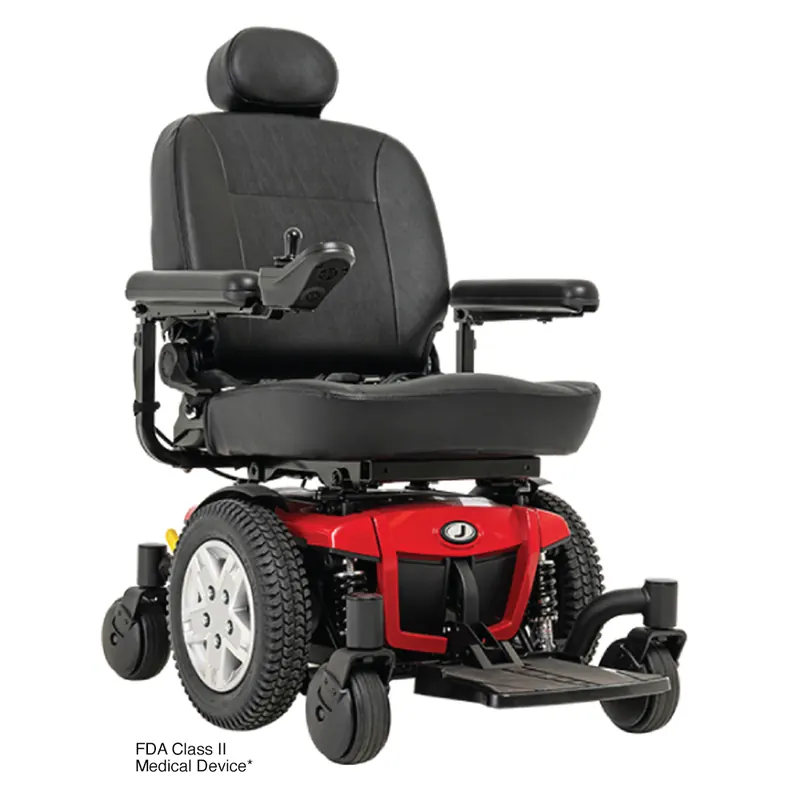
Pride Jazzy 600 ES: Best for small homes and tight spaces
Best for: Someone who’ll use the chair mostly at home and needs to turn around in narrow hallways, kitchens and bathrooms.
| Feature | Per Pride’s product sheet |
|---|---|
| Weight | Heaviest piece 124 lb (base); seat 51.8–54 lb; two 37 lb batteries |
| Max user weight | 300 lb |
| Range | 29.5 mi with a 200 lb rider; 24.8 mi with a 300 lb rider |
| Battery | Full-size chair; flies as a checked mobility device |
| Medicare code | Group 2 (K0822/K0823) |
The Jazzy 600 ES is a mid-wheel-drive chair with six wheels, and its 20.5-inch turning radius is the tightest on our list. Mid-wheel drive puts the drive wheels under you, so the chair turns close to its own center, a big help in homes with narrow doorways. Pride also publishes range at two rider weights, which is unusual and very useful (more on that in the buying guide). For more chairs built for tight homes, see our indoor-use guide.
Pros
- 20.5″ turning radius
- Up to 29.5 mi of range (200 lb rider)
- Medicare Group 2 codes; sold through Medicare-enrolled suppliers
Cons
- Doesn’t fold; the base alone is 124 lb
- Not something you’ll lift into a car
Skip it if: You need a chair that goes in a car trunk.
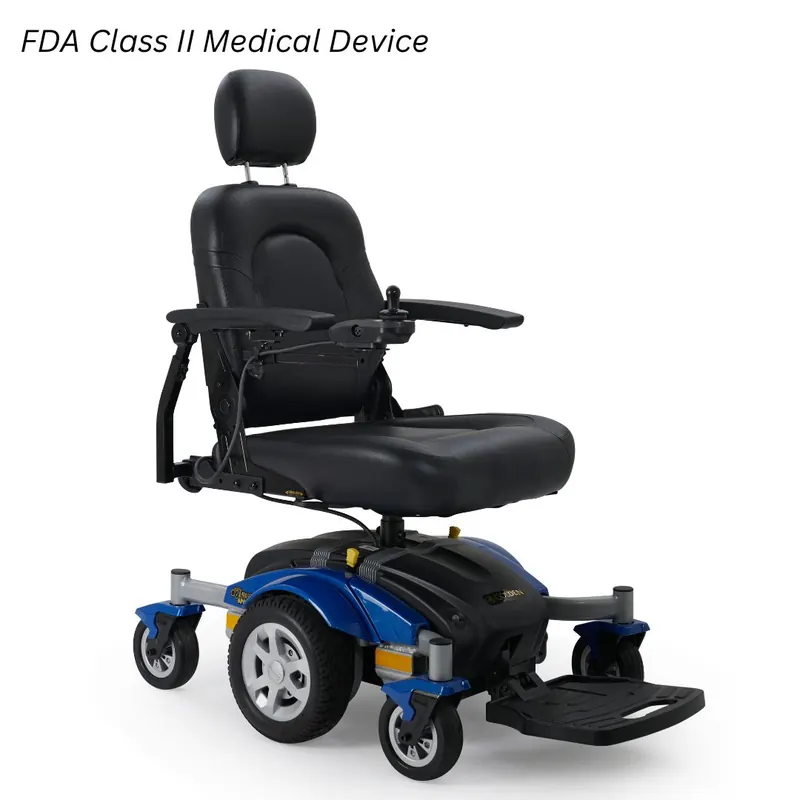
Golden Compass Sport GP605: Longest range in a full-size chair
Best for: Active riders who spend long days out and want the most range they can get.
| Feature | Per Golden Technologies |
|---|---|
| Weight | 179 lb assembled |
| Max user weight | 300 lb |
| Range | 24 mi standard; up to 34 mi with optional 50Ah batteries |
| Battery | Full-size chair (not a carry-on travel chair) |
| Medicare code | HCPCS K0823 |
The Compass Sport is a center-wheel-drive chair, so it shares some of the tight-turning benefits of the Jazzy 600 ES. Its headline is range: 24 miles as standard, and up to 34 miles with the optional larger batteries, the most on our list.
Pros
- Up to 34 mi with optional batteries
- Center-wheel drive for maneuvering
- HCPCS K0823
Cons
- 179 lb; needs a vehicle lift or accessible van to transport
Skip it if: Range isn’t your main concern.
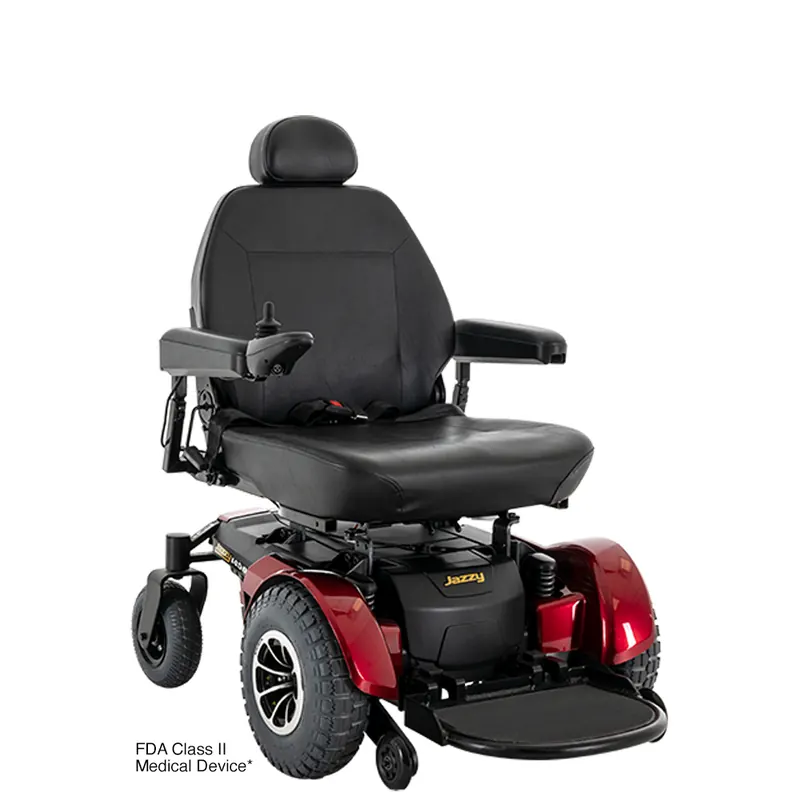
Pride Jazzy 1450: Best heavy-duty electric wheelchair
Best for: Riders who need a high weight capacity and a sturdier frame.
| Feature | Per Pride’s product sheet |
|---|---|
| Weight | Heaviest piece 195 lb; two 52 lb batteries |
| Max user weight | 600 lb |
| Range | Up to 16.5 mi |
| Battery | Full-size chair (not a carry-on travel chair) |
| Medicare code | Group 2 Very Heavy Duty (K0826/K0827) |
The Jazzy 1450 is built for riders well above the 300 lb limit most chairs share. It’s rated up to 600 lb, double most of the list. It uses front-wheel drive, which gives a 26.5-inch turning radius. That’s wider than the 600 ES, so measure tight spots at home.
Pros
- 600 lb user capacity
- Up to 16.5 mi of range
- Medicare Very Heavy Duty codes
Cons
- Very heavy; heaviest piece is 195 lb
- Wider turning radius than mid-wheel-drive chairs
Skip it if: The rider is under 300 lb. A standard chair will be lighter and easier to maneuver.
In Miami-Dade or Broward? See if you qualify for a power wheelchair
Take our free 60-second assessment. If it looks like a fit, a local mobility specialist can explain Medicare or insurance coverage and next steps, at no cost and with no obligation.
Buying guide: how to choose an electric wheelchair
Types of electric wheelchairs and drive types
Most power wheelchairs fall into two broad groups:
- Folding / portable electric wheelchairs (Jazzy Carbon, Journey Air Elite, ComfyGo, EZ Lite, Navigator PRO, Vive Airframe). They’re lighter, fold for a car trunk, and many are built with air travel in mind. The trade-offs are usually range, seat size and weight capacity. (See our upcoming guides to folding electric wheelchairs, lightweight electric wheelchairs and portable electric wheelchairs.)
- Full-size power wheelchairs (Jazzy 600 ES, Compass Sport, and Jazzy 1450). They offer more range, sturdier seating and higher capacity, but they weigh 150–250+ lb and need a vehicle lift or accessible van.
Where the drive wheels sit changes how the chair handles:
- Mid-wheel (or center-wheel) drive turns in the tightest space. The Jazzy 600 ES turns in 20.5 inches. Good for small homes.
- Front-wheel drive is often chosen for curbs and uneven ground, but it typically needs more room to turn. The Jazzy 1450 needs 26.5 inches.
- Rear-wheel drive is common on folding chairs like the Jazzy Carbon. It generally needs more room to turn than mid-wheel drive.
Weight and portability
Two numbers matter here, and listings often show only the more flattering one:
- Weight with the battery. “39 lb” sounds better than “43.6 lb,” but you’ll lift the chair with a battery in it unless you remove it every time.
- The heaviest single piece. This is what someone actually has to lift. The EZ Lite DX12 weighs 62 lb in total, but its heaviest piece is 37 lb, so it may be easier to load than a 44 lb chair that doesn’t come apart.
If a family member will load the chair, be honest about what they can lift safely. A chair that’s too heavy to load ends up staying in the garage.
Range: why “up to” figures run high
Every range number on a product sheet is a best case. Rider weight, hills, rough ground, heat and cold, and battery age all cut into it.
Pride’s product sheet for the Jazzy 600 ES shows this clearly. Pride rates the chair at 29.5 miles with a 200 lb rider, but 24.8 miles with a 300 lb rider. That’s about 16% less range from rider weight alone, on the same chair and the same batteries. Most manufacturers publish one number without saying what rider weight they used. Forcemech does: its 18-mile figure assumes a 150 lb rider on flat ground.
A practical rule: if the rider is heavier than average, or the chair will go up hills, plan around noticeably less than the advertised range, and pick a chair whose claimed range is comfortably more than your longest typical day.
User weight capacity and seat width
On our list, weight limits run from 225 lb (Vive Airframe) to 600 lb (Jazzy 1450). Leave some headroom. Don’t pick a chair whose limit sits right at the rider’s current weight, and remember that bags, a backpack or an oxygen tank on the chair count too. Running a chair near its limit also tends to shorten range.
Seat width matters for comfort and for skin health. If the rider sits for many hours a day or has special seating or positioning needs, ask a PT or OT to help with measurements and cushion choice. That’s exactly what they’re trained for.
Terrain and outdoor use
If the chair will spend real time outdoors on grass, gravel, cracked sidewalks or driveway slopes, look at three things:
- Ground clearance. How high the lowest part of the chair sits. The Navigator PRO has 3.5 inches.
- Suspension. It smooths bumps and helps keep the drive wheels on the ground. The Navigator PRO has four-point suspension.
- Climbing angle. The steepest slope the manufacturer rates the chair for. The Navigator PRO, for example, is rated at 12°.
Check the product sheet before counting on a travel chair for a gravel driveway or sloped yard.
Flying with an electric wheelchair
The FAA lets travelers fly with battery-powered wheelchairs, but lithium-ion batteries have limits. Per the FAA’s PackSafe guidance:
- A lithium-ion mobility device battery can be no more than 300 watt-hours (Wh).
- You may bring one spare battery up to 300 Wh, or two spares up to 160 Wh each, in carry-on baggage only.
- If the chair isn’t designed to protect the battery, the battery must be removed and carried in the cabin.
How to work out watt-hours: multiply the battery’s volts by its amp-hours. A 24V, 12Ah battery is 24 × 12 = 288 Wh, under the limit. EZ Lite’s optional 15Ah battery is listed at 360 Wh, over the limit, while its 10Ah battery (240 Wh) fits.
Full-size chairs like the Jazzy 600 ES usually fly as checked mobility devices, with handling arranged by the airline. Whatever chair you choose, call your airline before you book. Rules can vary by airline, and many ask for battery details in advance. (More in our upcoming guide to flying with a power wheelchair.)
Does Medicare cover electric wheelchairs?
Sometimes, but the rules are specific. According to Medicare.gov:
- Medicare Part B may cover a power wheelchair only when it’s medically necessary for use in your home.
- You need a face-to-face exam and a written order from a treating doctor or other provider.
- The chair must come from a Medicare-enrolled supplier. Some power chairs also need prior authorization.
- After you meet the Part B deductible, you generally pay 20% of the Medicare-approved amount.
Medicare-enrolled suppliers that provide power wheelchairs include:
Power Mobility Guide is independent and isn’t affiliated with these suppliers.
This is why HCPCS codes like K0822 or K0823 show up on some product sheets. They’re the billing codes suppliers use. Of our picks, the Pride Jazzy 600 ES (K0822/K0823), Golden Compass Sport (K0823) and Pride Jazzy 1450 (K0826/K0827) have codes published by the manufacturer or a supplier. Direct-to-consumer brands work differently: Journey, for example, doesn’t process insurance at all.
Coverage decisions depend on your health, your home and your plan. Medicare Advantage plans and Medicaid may have their own rules. Start with your doctor, and ask a Medicare-enrolled supplier what paperwork they need. (More in our upcoming Medicare power wheelchair coverage guide.)
In Miami-Dade or Broward? See if you qualify for a power wheelchair
Take our free 60-second assessment. If it looks like a fit, a local mobility specialist can explain Medicare or insurance coverage and next steps, at no cost and with no obligation.
Electric wheelchair vs. mobility scooter
A mobility scooter has a tiller (handlebars) and a seat on top, and it’s best for people who can sit upright, steer with both arms and get on and off on their own. A power wheelchair uses a joystick, turns in tighter spaces and usually gives more seating support, which makes it more practical indoors. If the main need is getting around the house, a power wheelchair is usually the better fit. Your doctor or therapist can help you decide. (Scooter guide coming soon.)
Frequently asked questions
What is the best electric wheelchair for seniors?
It depends on where the chair will be used and who will lift it. For travel and errands, the Pride Jazzy Carbon (43.6 lb, 300 lb capacity) is a strong all-rounder. If a caregiver will load it, the Journey Air Elite (29 lb) or EZ Lite DX12 (pieces of 37 lb or less) are easier to lift. For tight spaces at home, the Jazzy 600 ES turns in 20.5 inches. A doctor, PT or OT can help match the chair to the person.
How much does a good electric wheelchair cost?
Prices vary widely by type: lightweight folding chairs, full-size chairs and bariatric chairs sit in very different ranges, and prices change often. Medicare may cover a power chair when it’s medically necessary for use in your home. Check current prices at the retailer links above before you buy.
What is the lightest electric wheelchair?
Of the chairs we compared, the Journey Air Elite is the lightest at 29 lb with its battery (26 lb without), per Journey. Its weight limit is 240 lb.
How far can an electric wheelchair go on one charge?
Claimed ranges on our list run from up to 9 miles (Vive Airframe) to up to 34 miles with optional batteries (Golden Compass Sport). Real-world range is usually lower: Pride’s Jazzy 600 ES figure drops from 29.5 to 24.8 miles when the rider goes from 200 to 300 lb.
Can I take an electric wheelchair on a plane?
Usually, yes. The FAA limits lithium-ion mobility device batteries to 300 Wh, with one spare up to 300 Wh or two spares up to 160 Wh each, carried in the cabin. Check your chair’s battery watt-hours (volts × amp-hours) and call your airline before booking.
Does Medicare pay for an electric wheelchair?
Medicare Part B may cover a power wheelchair only when it’s medically necessary for use in your home. You need a face-to-face exam and written order from your provider, and the chair must come from a Medicare-enrolled supplier. You typically pay 20% of the approved amount after the Part B deductible. See Medicare.gov for details.
What weight capacity do I need?
Choose a chair rated comfortably above the rider’s weight, with room for bags or equipment. Capacities on our list range from 225 lb to 600 lb. Riding near the limit can also reduce range.
Can an electric wheelchair go on grass or gravel?
Some can. Look for ground clearance, suspension and a higher climbing rating. The Forcemech Navigator PRO has 3.5″ clearance, four-point suspension and a 12° rating. Many travel chairs are designed mainly for pavement and floors.
Sources
- Pride Jazzy Carbon product details: https://www.pridemobility.com/jazzy-power-chairs/jazzy-carbon/specifications.asp
- Journey Air Elite: https://www.shopjourney.com/products/journey-air-elite
- ComfyGo Majestic IQ-9000 AR: https://comfygomobility.com/products/majestic-iq-9000-ar-remote-controlled-electric-wheelchair-with-recline
- EZ Lite Cruiser Deluxe DX12: https://www.ezlitecruiser.com/products/ez-lite-cruiser-deluxe-dx12
- EZ Lite Cruiser compare models: https://www.ezlitecruiser.com/pages/compare-models
- Forcemech Navigator PRO (Hieline listing quoting Forcemech’s details): https://hieline.com/products/forcemech-navigator-pro
- Vive Health Airframe: https://www.vivehealth.com/products/airframe-power-wheelchair
- Pride Jazzy 600 ES product details: https://www.pridemobility.com/jazzy-power-chairs/jazzy-600-es/specifications.asp
- Golden Compass Sport GP605: https://goldentech.com/product/power-wheelchairs/compass-sport/
- Pride Jazzy 1450 product details: https://www.pridemobility.com/jazzy-power-chairs/jazzy-1450/specifications.asp
- FAA PackSafe, wheelchairs and mobility devices: https://www.faa.gov/hazmat/packsafe/wheelchairs-mobility-devices
- 49 CFR 175.10(a)(17): https://www.ecfr.gov/current/title-49/section-175.10
- Medicare.gov, wheelchairs and scooters: https://www.medicare.gov/coverage/wheelchairs-scooters
This guide is for general information and isn’t medical advice. Talk with your doctor, physical therapist or occupational therapist about which mobility device and seating setup is right for you.